
Is Your Cat’s Sense of Smell Superior to a Dog’s?
The longstanding debate about whether cats or dogs make better companions continues as new insights reveal fascinating details about their senses. Recent findings suggest that, while it may be a common assumption that dogs have a superior sense of smell, cats actually possess a stronger olfactory ability, at least under normal circumstances.

Olfactory Receptors: A Comparative Analysis
In examining the anatomy of smell, cats boast an impressive number of olfactory receptors—up to 200 million—far exceeding the mere 6 million found in humans. Dogs typically have around 100 million receptors. Yet, there are outliers; certain breeds like the Bloodhound have been meticulously bred for scent tracking over centuries, giving them nearly 300 million scent receptors, which notably surpasses that of cats.
The Unique Role of Bloodhounds
Bloodhounds, primarily bred for their tracking capabilities, illustrate a unique case in this discussion. Their extraordinary sense of smell enables them to excel in scent detection, making them an exception in the comparative analysis between cats and dogs.
Predatory Instincts: The Role of Smell in Cats
Cats, as apex predators, rely heavily on their sense of smell to hunt and track prey. This vital sense, combined with their other sensory skills, is crucial for their success in the wild. They have evolved to utilize their keen olfactory abilities to locate food, demonstrating the importance of smell in their survival tactics.
Understanding the Mechanics of Smell
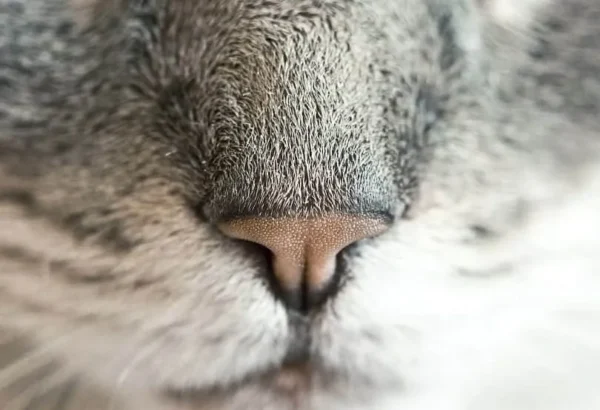
The quality of a sense of smell extends beyond the number of olfactory receptors. Factors such as the size of the olfactory epithelium—the tissue involved in scent detection—and the presence of specialized organs like the vomeronasal organ play significant roles. This organ is located on the roof of a cat’s mouth and is primarily used for detecting pheromones, acting as a direct link to the brain.
The Flehmen Response: A Closer Look
When observing a cat with its mouth slightly open and its head lowered, you might be witnessing the flehmen response. This behavior, exhibited by various animals, aids in drawing smells into the nasal cavity and the vomeronasal organ, enabling a deeper analysis of scents, particularly pheromones that regular olfactory sensors cannot detect.

Beyond Smell: Cats’ Other Senses
While a cat’s sense of smell is paramount, they also rely heavily on their eyesight and whiskers for navigation and hunting. Whiskers, or vibrissae, serve as sensory organs, helping cats gauge their surroundings and detect subtle changes in air pressure that signal the presence of prey.
Furthermore, cats possess a remarkable hearing ability, tuned to pick up high-pitched sounds that often escape human detection. Their ears feature a specialized flap, known as the Hunter’s flap, which aids in directing these sounds into their ears, enhancing their ability to hear the ultrasonic frequencies that mice use to communicate.

Taste: A Notable Weakness
Interestingly, dogs and humans surpass cats when it comes to the sense of taste. With an average of only 473 taste buds, compared to about 8,000 in humans and 1,700 in dogs, cats depend more on their sense of smell to determine the appeal of food than on taste itself.
In summary, while cats generally have a superior sense of smell compared to dogs, notable exceptions like the Bloodhound exist. Cats integrate their sense of smell with other heightened senses to effectively hunt and interact with their environment. All in all, every sensory capability of a cat is significantly more advanced than that of humans, with taste being the only exception.
Featured Image Credit: MariyaL, Shutterstock
News, insights, and useful advice, delivered to you.